
Brave New Wonders is a bold, idea‑driven factory‑automation sim that hands you a fleet of text‑driven automatons and a ruined, island‑scattered world to rebuild. The beta I played revolves around one elegant conceit: natural‑language commands are the primary interface, type plain‑text instructions (or use guided presets) and watch autonomous units interpret, cooperate, and improvise. That single design choice reshapes every system: logistics become choreography instead of conveyor‑belt puzzles, combat and exploration reward clever scripting, and factories feel alive as your instructions ripple through networks of machines.
The demo showcases the concept’s huge creative potential; emergent workflows, surprising interactions, and player‑invented solutions, but also exposes growing pains: ambiguous phrasing can produce brittle behaviours, large fleets of custom scripts need better debugging and visualization, and balance tweaks are still settling in. What follows is a focused look at the game’s systems, the beta’s standout moments, and the areas that need refinement before this promising sandbox reaches its full scale.
What it is
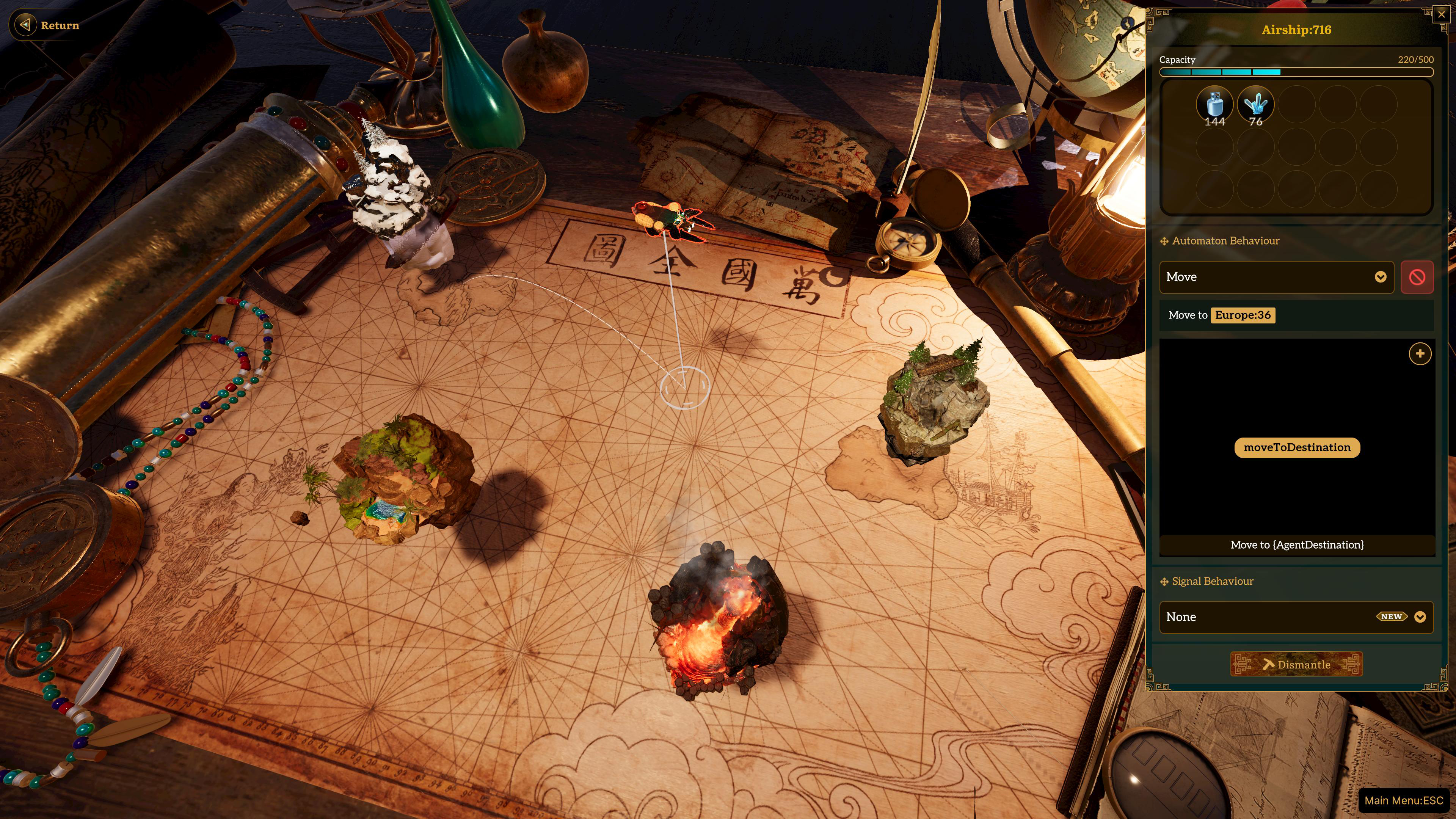
Brave New Wonders fuses base building, exploration, and light combat around a single, disruptive idea: you command a workforce of automatons with plain‑text instructions in any language. Rather than conveyor belts and fixed logistics, your scripted directives drive everything from resource hauling and factory choreography to coordinated assaults and tactical retreats, and the behaviour editor guides you as you iterate and refine complex routines. The archipelago‑style world, traversed by a massive airship that doubles as a mobile factory fleet, hides relics and guarded ruins whose discoveries branch your tech tree, steering each playthrough toward distinct automation philosophies and emergent strategies.

Core mechanics
• Text commands as gameplay: Automatons obey plain‑text instructions instead of rigid AI scripts. Use presets to get started or write bespoke behaviours to choreograph complex tasks; the behaviour editor offers guided templates and real‑time feedback, and clever phrasing often unlocks emergent, surprisingly efficient routines.
• No belts, emergent logistics: There are no conveyor belts, materials move because you tell machines to move them. The puzzle becomes scripting and timing: coordinating multiple bots, assigning priorities, and designing handoff rules replaces layout optimization and rewards orchestration over brute force.
• Factory and wonder building: Factories are modular systems that respond to your automaton rules, not passive production lines; tweak behaviours and building interactions to create self‑regulating supply chains. Wonders are expensive, game‑changing projects that synthesize your automation skills into visible, high‑impact achievements.
• Exploration and combat: Ruins conceal relics, hazards, and dormant machines that reshape your tech tree. Combat is tactical scripting; order squads to flank, fall back, focus fire, or rescue units, and success depends on clear priorities, fallback behaviours, and anticipating enemy patterns.
Progression and variety
• Custom tech tree: Relics unlock branching technologies that make every choice feel consequential and replayable. Each discovery steers your progression toward distinct automation philosophies; militarized combat doctrines, self‑sustaining ecological factories, or airborne production networks, so your strategy and playstyle evolve with every relic you claim.
• Islands and airship logistics: Islands differ in biome, resources, and strategic value, turning map selection into a meaningful decision. Your massive airship functions as a mobile base and flying factory fleet, forcing you to plan inter‑island routes, prioritize cargo, and balance on‑site production with long‑range logistics.
• Emergent outcomes: Freeform text commands let players invent workflows, signaling systems, and cooperative behaviours the developers never scripted. Those player‑driven solutions produce surprising, emergent interactions; creative shortcuts, elegant automaton choreography, and unexpected synergies, that become the game’s richest moments.

Beta strengths
• Command system potential: The core novelty is powerful. Even simple text rules produce satisfying, readable behaviours, and the editor’s guidance lowers the barrier to entry.
• UI improvements: Recent updates polish the behaviour editor and add an Economy View and Itempedia, which make tracking production and recipes far less opaque.
• Pacing and accessibility: Streamlined relic acquisition and earlier access to advanced behaviours help players reach the fun parts faster.
• Audio and polish: New music and added voice work for cinematics add atmosphere and make exploration feel weightier.
Beta rough edges
• Scripting friction: Natural‑language control is liberating but sometimes brittle, ambiguous phrasing or edge cases can produce unexpected automaton behaviour that requires debugging.
• Late‑game complexity: Managing dozens of custom behaviours across a sprawling factory can become overwhelming without stronger grouping, debugging, or visualization tools.
• Balance and economy: Some costs and power mechanics still feel in flux; the power‑pole connection limit and construction cost tweaks in the patch are steps in the right direction but more tuning will help pacing.
• Combat clarity: Battles are engaging but can be hard to read when many automatons act simultaneously; clearer combat telemetry would help players learn faster.
Tips for beta players
• Start with presets: Use the provided behaviours to learn patterns, then iterate with small, testable changes.
• Name and document rules: Keep a short log of command phrases and their intended effects, this saves time when debugging emergent failures.
• Use Economy View early: Track production and consumption numbers to spot bottlenecks before they cascade.
• Scout relics aggressively: Relics shape your tech tree; prioritize islands that unlock the tools you want to experiment with.
Final Verdict
Brave New Wonders’ beta delivers a bold, original spin on automation by making scripting the game’s primary interface. Letting players write plain‑text instructions turns the world into a creative sandbox: elegant, surprising emergent systems appear when your commands click, and the satisfaction of watching bespoke routines hum is genuine.
The demo shows clear momentum; sharper tutorials, a more transparent Economy View and Itempedia, and quicker access to meaningful tech choices make the core loop far more approachable than early builds.
To realize its full promise the game still needs stronger debugging and visualization tools for complex behaviours, clearer combat telemetry so large skirmishes are easier to read and learn from, and continued balance tuning across economy and power systems. For anyone who loves systems design, emergent AI, and the delight of teaching machines to cooperate, this beta is an imaginative, highly encouraging start.
Watch and Wishlist
• Why wishlist: Get Brave New Wonders and release notifications, patch notes, and sale alerts; wishlisting also helps support the indie developer and signals interest in future content drops.
• Platforms to track: PC storefronts (Steam, Epic) and major console stores (Nintendo Switch, Xbox, PlayStation) as releases roll out.
• How to stay informed: Follow City From Naught and Brave New Wonders on social channels, join the official Discord and the Steam page, and watch patch notes and dev posts for build and feature updates.
• Price perspective: To be determined; expect indie early‑access pricing (typically low‑to‑mid range) with an introductory discount or launch sale possible. Watch for seasonal promotions and bundle deals, and weigh purchase timing against the developer’s update roadmap and post‑release content to get the best value.
Key Takeaways
• Premise: A factory‑automation sim set in a post‑apocalyptic archipelago where you command text‑driven automatons to explore, fight, and build wonders.
• Core mechanic: Plain‑text instructions are the primary interface, presets speed you in, but bespoke commands let you choreograph hauling, combat, and complex workflows.
• Logistics rethink: There are no conveyor belts; logistics emerge from scripted behaviours, shifting the puzzle from layout optimization to timing, priorities, and bot cooperation.
• Progression and variety: Relics unlock a branching tech tree and steer playstyles toward militarized, ecological, or airborne automation approaches, making each run feel distinct.
• Exploration and stakes: Islands hide guarded ruins and relics; tactical scripting is often required for successful raids and safe scavenging.
• Beta strengths: The behaviour editor, Economy View, and Itempedia make the system approachable; faster relic unlocks and tutorial improvements help players reach creative automation sooner.
• Areas to watch: Scripting can be brittle with ambiguous phrasing, large fleets need better debugging/visualization, and combat/readability and balance still need refinement.
• Who should play: Ideal for systems designers, creative scripters, and players who enjoy emergent AI interactions and teaching machines to cooperate.
Game Information:
Developer & Publisher: City from Naught Inc.
Platforms: PC (reviewed)
Release Date: Coming soon
Score: 8.0 / 10
Brave New Wonders’ beta is an inventive, high‑potential automation sim: the natural‑language command system creates genuinely emergent moments and the updated tutorials, Economy View, and Itempedia make the core loop approachable. It loses points for brittle edge cases in scripting, limited debugging/visualization for large fleets, and combat readability that can obscure player intent. Strong foundations and steady polish put it well above average, promising and highly enjoyable for systems‑minded players, with a few clear areas to tighten before full release.
“8.0 / 10 - A bold automation sim that hands you the pen: teach your machines, then sit back and watch civilization rise again.”